


FutureG
Pentagon’s 5G/FutureG Office Received $500M
The funds allotted by President Donald Trump’s reconciliation package last summer, dubbed the One Big Beautiful Bill Act, famously poured record amounts into the Department of Homeland Security and its various sub-agencies. But an underdiscussed benefactor is the office responsible for 5G and futureG at the Department of War.
In an exclusive interview with GovCon Wire, Dr. Thomas Rondeau, principal director of futureG and 5G at DOW, told us that his office received $500 million from the OBBBA.
Full ArticleFutureG Director Keynotes Defense R&D Summit
Potomac Officers Club, the national capital region’s premier GovCon events, networking and media organization, is ecstatic to announce that Thomas Rondeau, the Department of War’s principal director for FutureG, will give a keynote address at the 2026 Defense R&D Summit on Jan. 29 at the Hilton McLean in northern Virginia.
DeepSig and SRS Chosen by FutureG to Lead OCUDU
ARLINGTON, Va.–(BUSINESS WIRE)–DeepSig, a pioneer in AI-native wireless communications software, today announced it has been awarded a contract under the National Spectrum Consortium (NSC) Spectrum Forward OTA, on behalf of the FutureG Office within the Office of the Under Secretary of Defense for Research and Engineering (OUSD(R&E)). Through this award, DeepSig will partner with leading RAN software developer Software Radio Systems (SRS) to deliver a scalable, carrier-grade RAN software stack for 5G, 6G, and AI-RAN in coordination with the Linux Foundation.
The Rules of Spectrum Are Changing As We Speak
Spectrum allocation is a very complicated game. It must balance the rights and priorities of many stakeholders, including the DoD and other federal spectrum users, commercial wireless players, new NGSO systems and legacy GSO satellites. And with the FCC potentially altering long-established patterns of spectrum allocation, and a dynamic sharing mechanism scheduled to be demonstrated in November, there’s no telling where the pieces will fall. Who comes out on top: the FCC’s Space Bureau? Wireless? SpaceX? Legacy GEO, which has managed to hold onto its precious bandwidths for decades?
For the past several months, the FCC—led by new head of the Space Bureau, Jay Schwarz—has made a concerted effort to streamline and reform satellite licensing processes. It has also announced the intention to open several new sections of bandwidth, including a proposal to open up the lower 37 GHz band, and adopted new sharing rules on the 37 band to encourage wireless innovation. In May, the FCC also proposed a rulemaking that would unleash spectrum across twelve additional bands, including the 12, 42 and 51 GHz bands.
Test Plans, Results, and Lessons Learned About Open RAN Integration
Abstract: The vision of the 5G Challenge competitions was to accelerate adoption of 5G open interfaces, interoperable subsystems, and multi-vendor solutions by fostering a large, vibrant, and growing vendor community dedicated to advancing 5G interoperability towards true plug-and-play operation. This report provides test plans, results, and lessons learned about 5G Open RAN multi-vendor interoperability and compliance during the 2022 and 2023 5G Challenges. Multiple vendors demonstrated O-RAN ALLIANCE subsystem interoperability and performance on a limited timeline with no prior integration or planning. Contestants made significantly faster integration progress when they were open to sharing and working together. Significant integration time was devoted to resolving configuration parameters and compliance mismatches (e.g., which options were selected). Stringently following software development best practices improves the speed and success of multi-vendor interoperability.
The National Telecommunications and Information Administration’s Institute for Telecommunication Sciences (NTIA/ITS) and the U.S. Department of Defense’s Office of the Under Secretary of Defense for Research and Engineering (OUSD(R&E)) partnered to execute prize-based 5G Challenge competitions to foster, accelerate, and expand Open RAN development and adoption. This included a key partnership with CableLabs as the host lab and system integrator to develop and execute the test strategy and activities. This report presents the methodology and results from this research to expand and improve Open RAN interoperability testing and thereby accelerate the adoption and development of Open RAN services. The 5G Challenges implemented an innovative multi-vendor interoperability testing paradigm for fifth generation (5G) cellular open radio access network (Open RAN) standards- based systems. This novel testing approach allowed true ad hoc multi-vendor interoperability testing to encourage new development and entrants into the 5G Open RAN marketplace. The research provides insights and recommendations for future activities that replicate and build on the 5G Challenge’s testing framework to further support multi-vendor deployments of O RAN ALLIANCE open central units (O-CU), open distributed units (O-DU) and open radio units (O-RU). The O-CU hosts the control plane and user plane functions and protocols that control radio resources, packet data convergence, and transport layer processing. The O-DU hosts various protocol layers for base band processing and data transmission. The O- RU converts the radio signals from the antenna to digital signals sent to the O-DU and vice versa.
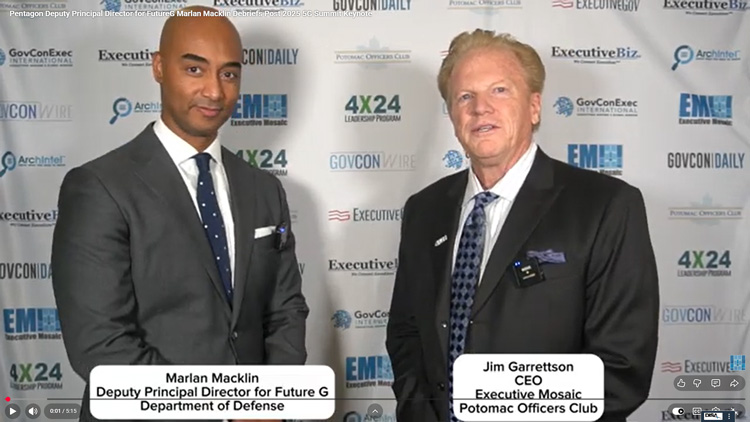
Pentagon Deputy Principal Director for FutureG Marlan Macklin Debriefs Post 2025 5G Summit Keynote
DoD Preparing Spectrum-Sharing Demo
The Pentagon is preparing a large-scale demonstration of dynamic spectrum-sharing technology this November, to explore how the military and commercial sectors can jointly use the lower 3 GHz band without compromising national security. This effort, led by the Department of Defense’s (DoD) FutureG office and the Office of the Chief Information Officer, follows a December 2024 solicitation seeking industry proposals, notes DefenseScoop.
The lower 3 GHz band is critical for both defense systems and commercial 5G, making spectrum sharing a contentious issue. The demonstration comes following years of back and forth between the Defense Department and the telecommunications industry over access to the 3.1-3.45 GHz S-band used by the Pentagon to operate different radars, weapons and other electronic systems. The telecom industry wants part of that spectrum to meet rising demand for commercial and civil 5G wireless technology, Inside Towers reported.
Pentagon seeks open-source software for 5G, 6G networks
WASHINGTON — As the US military makes big bets on 5G and future 6G networks for everything from streamlining supply lines to controlling combat robots, it doesn’t want to be beholden to the handful of huge tech firms that dominate the market today. So the Pentagon will soon seek bids to develop prototype “open” software — code that any company can freely access and deploy on its devices — in hopes of breaking down barriers to innovation.
Pentagon sets November timeline for largest-ever spectrum sharing demo
WASHINGTON — The Defense Department is planning to host the largest-ever spectrum sharing demonstration with industry in November, an official from the Pentagon’s FutureG office revealed Wednesday, in hopes of answering key questions amid a contentious debate.
“The real gap that we’ve had in these past spectrum sharing projects has been scale. They’ve been frankly under-resourced concepts on a table, maybe in a lab, maybe one or two outdoor experiments here and there. But nothing at this scale, which is a large-scale, multi-domain spectrum-sharing demonstration,” Tom Rondeau said during a panel at the Apex Defense Conference. “So that’s the really exciting part.”
Pentagon’s FutureG Office gearing up for new prototyping effort
The National Defense Education Program (NDEP) Funding Opportunity Announcement (FOA) is now on Grants.gov, announcement HQ0034-20-S-FO01. The Department of Defense (DoD) seeks innovative applications on mechanisms to implement Science, Technology, Engineering, and Mathematics (STEM) education, outreach, and/or workforce initiative programs. The Department intends to award multiple grants, subject to the availability of funds. Activities will support the DoD STEM strategic plan and align to the 2018 Federal STEM strategic plan. Suspense for applications is 24 FEB 2020.