Technology Transfer, Transition and Commercial Partnerships

Director: Mr. Stephen Luckowski
MISSION

DoD T3CP Office has primary responsibility for strategic partnerships and leveraging intellectual property developed (1) at the over 240 DoD labs and, (2) by performers of extramural, DoD-funded R&D, for maximum capability, technology superiority, and economic and national security.
(1) Laboratory Technology Transfer (T2) community enables public-private partnerships for the sharing of expertise, intellectual property (IP), and resources for the advancement of technology development benefiting the U.S. warfighter and national economy.  The Technology Transfer, Transition and Commercial Partnerships (T3CP) Office coordinates across the T2 community to:

  • Ensure statutory compliance
  • Provide corporate support
  • Lead in strategic coordination
  • Represent the Department in engagements with external stakeholders
  • Establish departmental policy

(2) Extramural research, funded by the DoD, is performed at universities and industry.  In accordance with Bayh-Dole, the performer has the right to retain title to subject inventions, the Federal government has “government purpose rights,” and the performer must prioritize domestic manufacturing in commercialization of the subject invention. T3CP is responsible for implementing iEdison as the DoD repository for all subject inventions, and to streamline DoD’s exercise of associated Government-purpose rights.

VISION

Led by T3CP, the DoD T2 community is a trusted innovation pathway providing strategic partnerships and leveraging intellectual property for maximum capability, technology superiority, and economic prosperity to benefit the nation.


Transferring DOD IP and capabilities to commercial entities, it makes available innovative products and services for transition into the military services

LEGISLATIVE AUTHORITIES:

Title 15 (Commerce & Trade): To leverage the full use of the nation’s Federal investment in R&D by transferring the results to the private sector in order to improve the economic, environmental, and social well-being of the U.S. (ref. 15 USC §3702 and §3710). Benefits include: private sector access to and collaboration with taxpayer funded Federal innovation and supporting assets; and more robust innovation ecosystem and industrial base.

Title 10 (Armed Forces): To enable and support the mission of the DoD through mutually beneficial partnerships with the private sector that facilitate collaboration, use of unique assets and capabilities, improved business practices, etc. Benefits include: access to and collaboration with non-government developed innovation, subject matter experts, facilities, etc.; leveraged and shared costs and risks; and decreased cost of ownership.

GUIDING DOCUMENTS: DoD Instructions 5535.08 and 5535.11

T3CP Goals and Associated Strategies

Build on foundation of successes across T2 enterprise

Elevate value of DOD IP portfolio

    • Establish complete and discoverable repository of all DoD IP to include all intramural and extramural inventions and commercial partnerships with the DoD labs

Encourage consistent T2 practices across enterprise

    • Update existing documents and survey T2 community for guidance gaps

Amplify impacts of T2

    • Promote the value of T2 through partnering and communication strategies that strengthen Office of Research & Technology Applications’ (ORTA) activities and transition opportunities

Continually improve T2 professional skills

    • Develop and monitor Technology Transfer University curricula and ORTA completion rates

T3CP Responsibilities

  • Develop DoD policy for T2 and guidance for its implementation (DoDI 5535.08 & 5535.11)
  • DOD INSTRUCTION 5535.08 -DOD DOMESTIC TECHNOLOGY TRANSFER PROGRAM
  • Availability of Samples, Drawings, Information, Equipment, Materials, and Certain
    Services to Non-DoD Persons and Entities
  • Encourage T2 and resolve policy issues through and across the DoD Components
  • Coordinate with DoD Components and other stakeholders on DoD T2 best practices, awards program, professional development, strategy, etc.
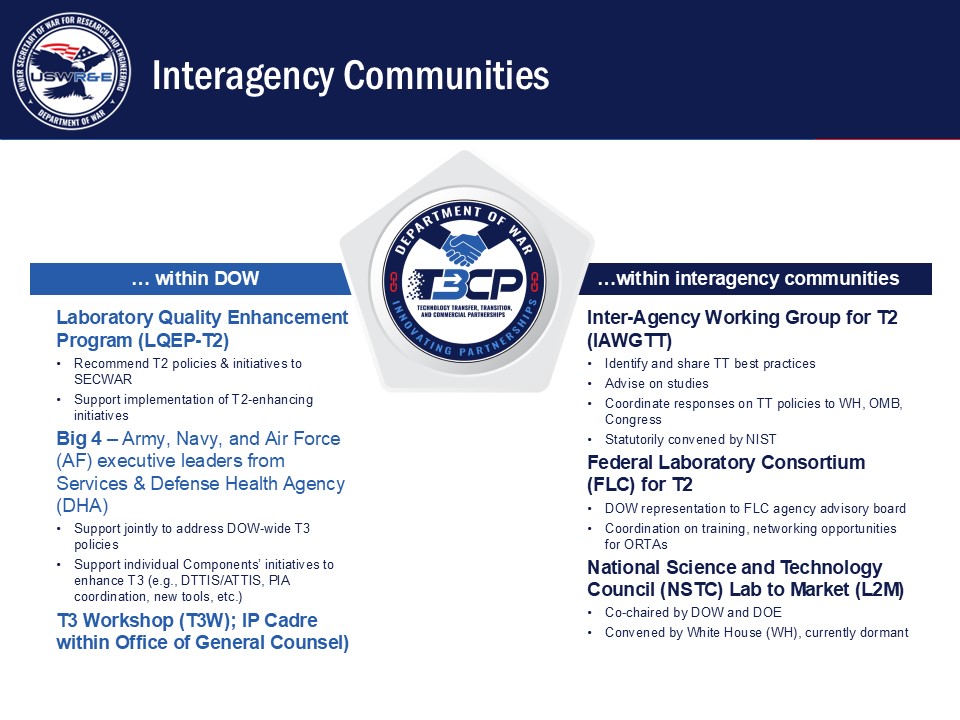
  • Most coordination activities occur through:
    • Laboratory Quality Enhancement Program-Technology Transfer (LQEP-T2)
    • T3 Workshop
    • Inter-Agency Working Group for T2
    • National Science and Technology Council Lab to Market
    • Federal Laboratory Consortium for T2.

The Value of IP:

"The patent system added the fuel of interest to the fire of genius”

                – Abraham Lincoln

  • In the ever-evolving landscape of intellectual property (IP), one cannot ignore the immense significance it holds for some of the world’s largest corporations. The value of IP is not just a statistic; it’s a critical component of modern business strategy. Consider this eye-opening fact: for Fortune 500 companies, IP often accounts for more than two-thirds of their overall value.
  • On average, IP assets make up more than 65 percent of the total worth of Fortune 500 companies. However, this percentage isn’t a uniform figure across the board; it varies significantly based on the industry and the company’s specific focus.
  • In fact, for certain companies within the Fortune 500 group, the value of their intellectual property assets exceeds a staggering 90% of their total value.*

* TTConsultants, Decoding the Worth: The World of IP Valuation, Retrieved January 8, 2024

DOD Technology Transfer and Transition (T3CP)
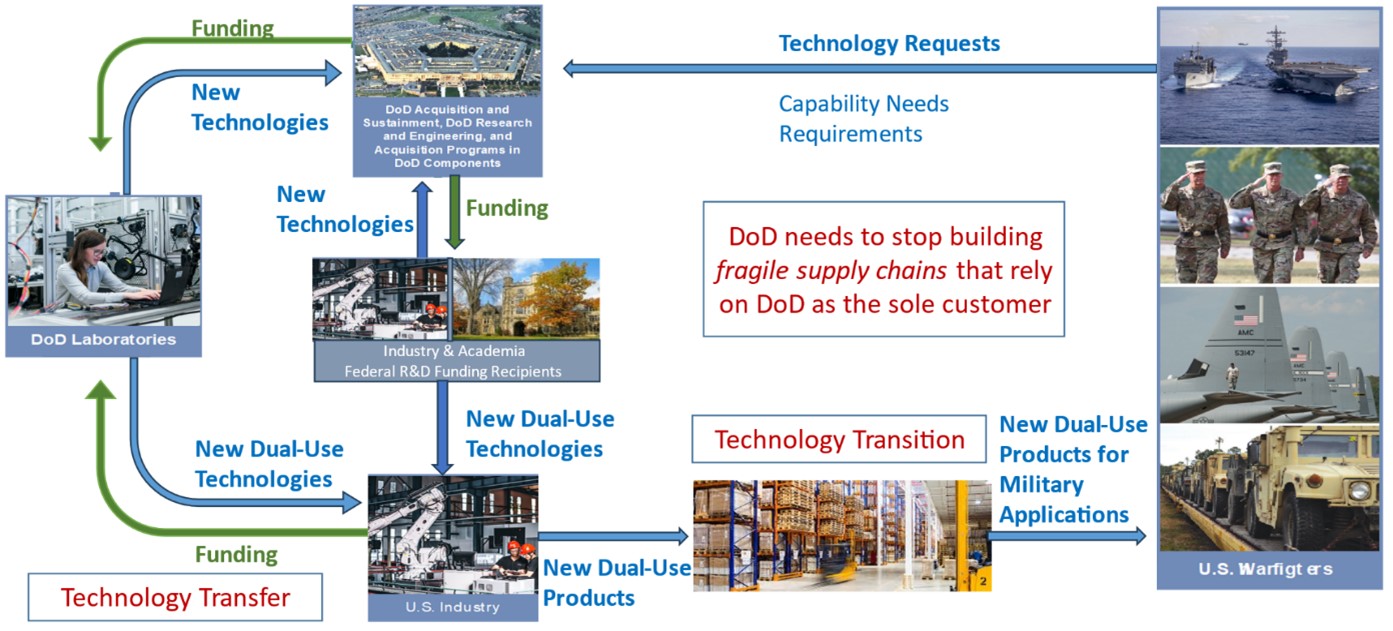
Technology Transfer and Innovation Visual Overview

Technology Transfer (T2) Mechanisms – Engaging External Partners

Federal T2 mechanisms include, but are not limited to:

  • Cooperative Research and Development Agreement (CRADA): R&D collaboration agreement with non-Federal entity covering a defined scope of work; funds may be provided to Government, but Government cannot provide funds to non-Federal entity under a CRADA, includes granting of rights to subject matter inventions
  • Patent License Agreement: licensing of federally owned inventions that may grant non-exclusive, partial, or exclusive rights to make, use, offer to sell, or sell products that include patented invention
  • Educational Partnership Agreement: agreement with educational institutions for enhancing scientific disciplines
  • Partnership Intermediary Agreement: non-profit, state-based partnership intermediary engaging small businesses and academia on behalf of Government to accelerate T2 and transition

For example: DoD TechLink and MilTech

  • Commercial Test Agreement or Test Service Agreement: service agreement used at Government testing facilities, expected cost reimbursement

DoD’s National Partnership Intermediaries

  • What is a partnership intermediary?
    • Partnership intermediaries are state or local government entities that work with DoD and other Federal agencies to facilitate technology transfer and commercialization activities as specified in 15 U.S.C. § 3715 and 10 U.S.C § 4124.
  • Established in 1999 as the first national partnership intermediary for DoD, TechLink has played a crucial role in U.S. innovation, facilitating license agreements that move inventions from labs to American businesses and into products and services that benefit society and the U.S. military.

TechLink