Expeditionary and Tactical Use (ETU)
Expeditionary and Tactical Use (ETU) delivers rapidly deployable networks for tactical operations by leveraging the increasing overlap between commercial mobile network capabilities and warfighting needs. These scalable, interoperable, and resilient warfighting networks integrate commercial cellular and traditional military equipment to execute Combined Joint All-Domain Command and Control (CJADC2) with allies and partners. Investment areas include waveform resilience for tactical and expeditionary environments; simplified network deployment (logical and physical), management, and orchestration; and heterogenous network integration for NATO Ally and Partner Force interoperability and interchangeability.
Delivering Information Advantage to the Warfighter
We Aim To:
Enable heterogenous network integration for Partner Force interoperability.
Enhance FutureG waveform resilience for tactical and expeditionary environments.
Simplify FutureG network deployment, management, and orchestration.
Highlighted Projects:
ETU focuses on innovation that enables commercial network technologies in tactical operations. These highlighted projects demonstrate ETU's commitment to delivering robust and adaptable 5G solutions:
Army 5G Tactical Mobility: This project is developing a cost-effective, combat-ready 5G prototype equipped with On-The-Move Command and Control capabilities to meet latency, throughput, range, and resiliency requirements. This project will address operational needs and future Secure Cellular Project requirements for survivability of Army networks to include the distributed Command Post.
Scalable Interoperable Resilient-5G (SIR-5G): This project leverages standard 5G capabilities to establish a scalable, interoperable, and resilient warfighting network for NATO. Utilizing 5G secure roaming, RAN Sharing, and interoperability between a 5G core and various tactical radios, SIR-5G positions NATO as a 5G service provider.
NATO Digital Backbone Experiment (DiBaX) 2025
From October 27 to November 7, 2025, a FutureG Office-funded team, comprised of MITRE, Idaho National Laboratory (INL), NATO Cooperative Cyber Defence Centre of Excellence (CCDCOE), and in collaboration with the U.S. Marine Corps Tactical Systems Support Activity (MCTSSA), actively participated in NATO DiBaX 2025.
The FutureG team played a pivotal role in implementing the DiBaX network architecture through the instantiation of the FutureG SIR-5G architecture. They also led the development of operational scenarios demonstrating the scalability, interoperability, and resilience of integrated 5G capabilities for NATO Coalition forces.
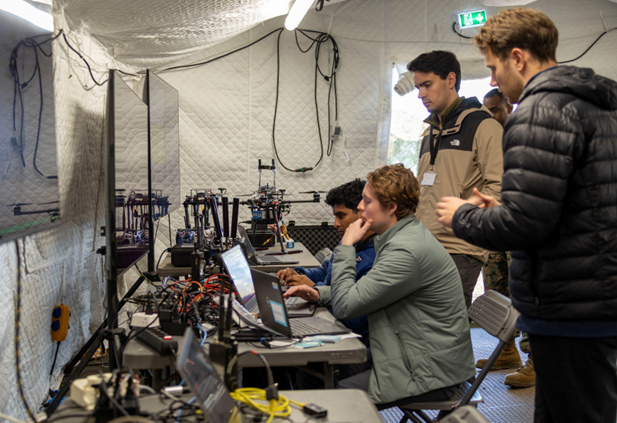
From October 21 - November 2, 2024, the FutureG Office participated in the NATO DiBaX 2024 hosted by NATO ACT. FutureG took a leading role in the DiBaX network architecture and operational scenario development to show how integrated 5G capabilities provide a scalable, interoperable, and resilient communications fabric for NATO forces. Key FutureG contributions at DiBaX 2024 include secure 5G roaming, radio access network (RAN) sharing, and the integration of heterogeneous tactical radio networks with a 5G core network. The integrated 5G capabilities were demonstrated during the DiBaX Observer Day on October 31, 2024, as the NATO MNB employed them to conduct a nighttime mechanized assault with support from unmanned air and ground platforms.